Quality Education

Universitas Islam Indonesia (UII) is dedicated to prioritizing lifelong learning and inclusive education for all, extending its educational resources and academic programs to benefit not only enrolled students but also the broader community. Through an expansive portfolio of open public lectures, expert symposia, competency-based vocational certifications, and community educational outreach, UII ensures that individuals from all walks of life have barrier-free access to opportunities that foster intellectual and professional development. These initiatives embody UII’s institutional mission as an institution accredited ‘Unggul’ by the National Accreditation Board for Higher Education (BAN-PT Decree No. 2003/SK/BAN-PT/AK-Ppj/PT/XII/2022), advancing the United Nations Sustainable Development Goal 4 (Quality Education).
In its pursuit of inclusive education, UII actively reaches out to diverse socio-economic groups, offering programs that cater to a wide range of community needs. Operating from its centralized facilities—including the Moh. Hatta Central Library (accredited ‘A’ by the National Library of Indonesia) and dedicated academic directorates—UII organizes sustained community outreach initiatives aimed at transferring practical skills, scientific literacy, and ethical values to underserved populations. By addressing the specific needs of marginalized groups and rural communities, UII works to reduce educational barriers and promote equity in lifelong learning opportunities.
Moreover, UII’s institutional policies further reinforce its commitment to ensuring that all members of society, regardless of their background, can engage in continuous learning throughout their lives. Enacted through formal university regulations, these policies guarantee non-discriminatory access across ethnicity, religion, disability, immigration status, and gender. Supported by university-wide academic quality guidelines and inclusive campus services, UII fosters a welcoming environment that values diversity and promotes long-term educational empowerment.
By institutionalizing an environment that values lifelong learning, UII plays an essential role in advancing knowledge, skills, and societal progress. From free on-site library services and open-access electronic journal publication (DOAJ-indexed) to recurring national expert lectures and accredited vocational training, the university ensures that higher education remains accessible and socially impactful, empowering communities to adapt and thrive in a rapidly changing world.
UII Lifelong Learning & Quality Education Performance Matrix
Verified Baseline Data for THE Sustainability Impact Ratings (SDG 4: Quality Education)
Lifelong Learning and Inclusive Education at Universitas Islam Indonesia (UII)
Access to Educational Resources for the Public
Universitas Islam Indonesia provides free and open access to a comprehensive suite of educational resources for individuals outside the university community, covering physical facilities, digital repositories, and certified learning courses:
- Free Access to Campus Facilities & Equipment: Members of the general public, independent researchers, schoolteachers, and students from other universities enjoy barrier-free access to UII’s central library facilities at the Moh. Hatta Building. Visitors can freely utilize open-access book stacks, reference collections, reading halls, and specialized public corners without charge during regular opening hours (Monday–Friday 08:00–21:00 WIB and Saturday 08:00–16:00 WIB). As a library accredited ‘A’ by the National Library of Indonesia (Perpusnas RI), UII hosts specialized national knowledge resources accessible to all, including the Indonesian National Standard Corner (SNI Corner, established with the National Standardization Agency / BSN), the Australian Corner (‘Aussie Banget’), the Kimpulan Temple Educational Heritage Site, and shared catalog access through the Jogjalib consortium.
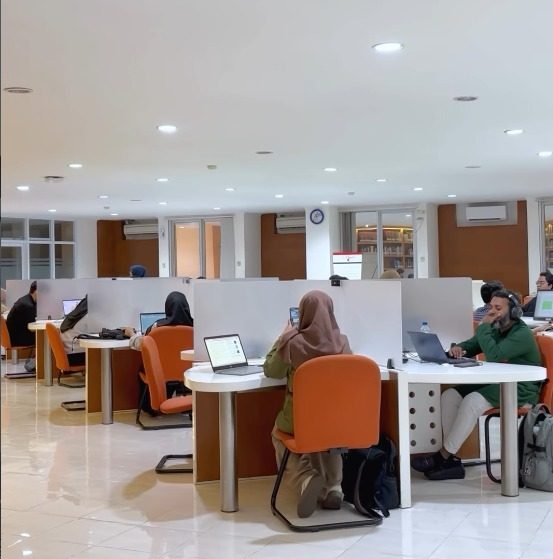
Free Study Space in Library
- Free Access to Online Knowledge Resources: UII operates an open-access journal publishing system (journal.uii.ac.id) serving as an official member of the Directory of Open Access Journals (DOAJ) and indexed in BASE (Bielefeld Academic Search Engine), ARJUNA, and SINTA. UII publishes dozens of peer-reviewed journals—including EJEM, Jurnal Hukum IUS QUIA IUSTUM, JAAI, JSB, JSTL, and community service journals such as JAMALI—all freely downloadable globally without subscription fees. UII also provides free open educational video archives on official YouTube channels and public research guides on library.uii.ac.id.

UII’s Main Library Corridor
- Free Courses Leading to Certificate or Award: UII provides free open educational courses and research capacity-building workshops for external participants. Through the Central Library’s Open Information Literacy & Scientific Writing Clinics and university open online modules, non-student participants can freely register, complete interactive instructional sessions, and receive digital certificates of completion verifying mastery of digital reference tools, academic integrity, and research methodologies.
Public Main Campus Library of Universitas Islam Indonesia
Journal Portal of Universitas Islam Indonesia
Table 1: Institutional Matrix of Free Public Educational Resources (Indicator 4.3.1)
Verified accessibility parameters for external learners, visiting scholars, schoolteachers, and public researchers.
Public Lectures and Community Events
UII regularly hosts major academic and educational events that are open to the general public and entirely free of charge, fostering intellectual discourse and lifelong learning across diverse community sectors. Coordinated through university academic directorates and faculties, these events operate with no admission or registration fees for external participants.
Flagship public lecture series documented on UII’s academic portal (academic.uii.ac.id/perkuliahan) include the recurring UII Postgraduate Public Lecture Series (Kuliah Umum Pascasarjana), featuring strategic national discourses such as:
- The 22nd Postgraduate Public Lecture: ‘Addressing Food Security Challenges Amid Global Climate Crisis’ (Menjawab Tantangan Ketahanan Pangan di Tengah Krisis Iklim Global);
- The 21st Postgraduate Public Lecture: ‘Academic Integrity and Leadership in the Digital Era’ (Integritas Akademis dan Kepemimpinan di Era Digital);
- International Relations Public Symposium: ‘The Normative Contestations of the Liberal International Order’.
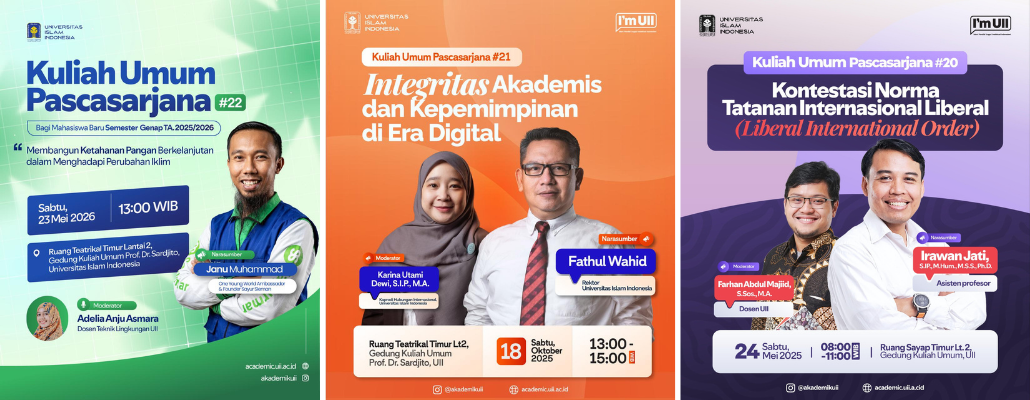
Sample of UII’s Flagship Public Lecture Series
Additionally, UII convenes university-wide Expert Lectures on Core Compulsory Courses (Kuliah Pakar MKWU Terpadu), engaging public participants, schoolteachers, and students on critical societal issues, notably ‘Internalizing Anti-Corruption Values in Academic and Public Life’ (Internalisasi Nilai Anti-Korupsi).
All of these educational events are universally accessible to external attendees through open online registration, live institutional broadcasts via official YouTube channels, and publicly accessible digital event archives, ensuring completely free civic and academic participation.
Islamic Economy Studium Generale
Faculty of Law Studium Generale (Available on YouTube for Public Views)
Table 2: Register of Free Educational Events Open to the General Public (Indicator 4.3.2)
Institutional lecture series and symposia documented on academic.uii.ac.id/perkuliahan/ (100% Free of Charge).
Vocational Training and Professional Certifications
Through the accredited Professional Certification Institute (LSP UII) and the CILACS Language Center, UII offers comprehensive vocational training, executive education, and competency certification services accessible to both enrolled students and the general public, aiming to build a skilled, adaptable workforce. LSP UII operates as a professional certification body officially licensed by the Indonesian National Professional Certification Board (BNSP) and is strategically integrated into UII’s Growth Hub under the Directorate of Coaching & Development of Entrepreneurship (originating from the European Commission Erasmus+ GITA project).
To cater to diverse adult learners, working professionals, and community entrepreneurs, UII delivers vocational training across two distinct operational tracks:
- Programmed Certification Courses: Regularly scheduled national qualification schemes certified by BNSP, including Chemical Laboratory Technicians, Halal Production Supervision, Logistics Management, and professional foreign language certification programs (English, Arabic, Japanese, and Mandarin) administered on a structured semester schedule by CILACS UII.
- Ad-hoc Community & Industry Workshops: Responsive, tailor-made vocational short courses organized in collaboration with regional business associations, village-owned enterprises (BUMDes), and local entrepreneurship groups, focusing on practical digital marketing, financial bookkeeping, and vocational workplace competencies.
These dual operational tracks ensure that non-student community members and industry practitioners have continuous access to accredited vocational education essential for professional advancement and sustainable livelihoods.
Professional Certification Institute (LSP UII)
Directorate of Coaching & Development of Entrepreneurship/Growth Hub
Erasmus GITA initiative by Directorate of Coaching & Development of Entrepreneurship/Growth Hub
Table 3: Accredited Vocational Training & Professional Certification Portfolio (Indicator 4.3.3)
Dual operational tracks (Programmed Qualification Schemes & Responsive Ad-hoc Workshops) open to external learners.
Outreach and Engagement Beyond Campus
Universitas Islam Indonesia is actively engaged in educational outreach activities beyond campus boundaries, delivering tailored instructional workshops, academic enrichment, and literacy programs directly into local elementary schools and rural community centers. Coordinated primarily through the Directorate of Research and Community Services (DPPM UII), this outreach is structured into both programmed and ad-hoc initiatives:
- Programmed Educational Outreach: Institutionalized, recurring semester-based programs including the mandatory Thematic Community Service (KKN Tematik) and Student Teaching Assistance (Asistensi Mengajar). University faculty supervisors and trained student cohorts are deployed on prolonged assignments to regional primary schools and village learning centers across Sleman and neighboring regencies in D.I. Yogyakarta. These programs focus on foundational literacy tutoring, basic numeracy and science education for primary school pupils, creative environmental learning, and pedagogical capacity-building for rural educators.
- Ad-hoc Community Learning Initiatives: Targeted, responsive outreach events conducted by academic departments, faculties, and student volunteer organizations, including mobile science and robotics demonstrations at local schools, emergency disaster-literacy clinics for vulnerable communities on the slopes of Mount Merapi, and ad-hoc educational workshops requested by village administrations.
- Active Participation in SEA Teacher Program: Since 2018, UII has actively contributed to the SEA-Teacher Program organized by the Southeast Asian Ministers of Education Organization (SEAMEO) to strengthen international teaching practice and pre-service teacher education across Southeast Asia. Although the program was temporarily suspended during the COVID-19 pandemic, UII successfully resumed its active engagement. For instance, in the August-September 2026 period, UII deployed 11 student teachers from the Department of English Language Education across three host countries–placing three students at Brainy Bunch International School in Malaysia, three at Kuwait Pittayapat School in Thailand, and five at Panpacific University in the Philippines. Furthermore, UII delegates consistently participate in SEAMEO’s regional evaluation meetings (such as the 11th Cohort meeting in Manila) to advance policy development, digital teaching practices, and sustainable educational governance throughout the region.
By maintaining both continuous programmed deployments and responsive ad-hoc outreach, UII directly bridges university academic expertise into underserved communities, advancing equitable educational access outside formal university walls.

Teacher Education Collaboration in Southeast Asia through the SEA-Teacher Programme
Table 4: Educational Outreach Activities in Local Schools & Communities (Indicator 4.3.4)
Institutional outreach deployed beyond university campus into underserved rural schools and local communities.
Commitment to Inclusivity and Accessibility
UII has established comprehensive, formal institutional policies ensuring that all educational activities, lifelong learning opportunities, and campus facilities are universally accessible to individuals of diverse backgrounds, strictly prohibiting discrimination based on ethnicity, religion, disability, immigration status, or gender.
These statutory commitments are formally codified and actively reviewed within university regulatory instruments enacted during the 2022–2026 assessment period:
- University Regulation (Peraturan Universitas) No. 1 Year 2022 on the Internal Quality Assurance System (SPMI – MERCY OF GOD Standards): Codifies the institutional standard for non-discriminatory educational services, equitable resource access, and inclusive learning environments across all university directorates;
- UII Academic Guidance Manual (Panduan Akademik UII, Academic Year 2024/2025): Mandates equal participation rights, transparent evaluation, and administrative pathways for Recognition of Prior Learning (RPL / Rekognisi Pembelajaran Lampau) for external learners;
- Rectoral Regulations on Educational Accessibility & Disability Accommodations: Enforces barrier-free physical infrastructure (ramps, tactile paving, designated elevators) and academic accommodations for students and visitors with disabilities.
Published openly on UII’s academic and quality assurance portals (academic.uii.ac.id and bpm.uii.ac.id), these formally ratified policies guarantee that lifelong learning at UII remains universally welcoming, legally protected, and barrier-free for all members of society.
Table 5: Statutory Policies Guaranteeing Inclusive Access to Lifelong Learning (Indicator 4.3.5)
Legally enacted regulatory instruments reviewed within 2022–2026 protecting all five mandatory demographic categories.