
Clean Water and Sanitation

Universitas Islam Indonesia (UII) has long been committed to environmental stewardship, and this is reflected in its proactive measures to manage water usage and ensure sustainability across campus. Recognizing the importance of water conservation, UII has implemented several initiatives that focus on minimizing water consumption, promoting wastewater treatment, and providing clean water access to all members of the university community. These actions align with UII’s broader environmental goals and demonstrate the university’s commitment to reducing its ecological footprint.
In line with its dedication to sustainable water management, UII has also adopted policies and systems aimed at maximizing water reuse throughout the campus. These initiatives focus on conserving water by reducing overall consumption and implementing water recycling practices for various campus needs, from irrigation to cleaning. By integrating these practices into its daily operations, UII ensures that water resources are utilized efficiently and responsibly, setting an example for other institutions to follow.
Beyond its internal efforts, UII plays an active role in promoting water conservation and good water management practices within the surrounding community. The university’s initiatives extend beyond the classroom, engaging in community outreach and partnerships to raise awareness about the importance of sustainable water usage. UII works collaboratively with local stakeholders to support water conservation projects and ensure that the surrounding communities have access to clean and safe water.
Through these ongoing efforts, UII demonstrates its dedication to creating a sustainable future, both on campus and beyond. By prioritizing water conservation and sustainable water management, the university not only reduces its environmental impact but also empowers its community to adopt responsible practices that contribute to a healthier planet. These initiatives reinforce UII’s broader mission of promoting environmental sustainability and advancing the well-being of future generations.
Water Usage and Care Measures at Universitas Islam Indonesia (UII)
Measurement of Water Usage
Universitas Islam Indonesia systematically monitors and regulates its campus-wide water extraction and distribution to ensure equitable supply, minimize pipeline leakage, and protect regional Merapi volcanic aquifers. Physical water operations across campus are managed by the Directorate of Occupational Health, Safety, and Environment (Direktorat Kesehatan, Keselamatan Kerja, dan Lingkungan Hidup – DK3LH) through its Division of Facilities and Infrastructure (Divisi Sarana dan Prasarana), in strategic coordination with the Directorate of Resource Utilization and Sustainability.
Campus water is primarily extracted through licensed deep borehole aquifer wells, which feed into the central university distribution grid. In compliance with regional environmental regulations and Sleman Regency Groundwater Tax (Pajak Air Tanah – PAT) mandates, UII maintains calibrated digital and mechanical flow meters on all deep well extraction heads. In addition, sub-meters are installed across major academic faculty complexes, student dormitories (Pondok Pesantren and Rusunawa), laboratories, and administrative centers to track consumption trends, prevent distribution losses, and optimize resource efficiency. By strictly capping and regulating this internal grid, UII ensures that campus extraction remains entirely self-contained and operates without depleting or negatively impacting the water supply of surrounding local neighborhoods.
| Data Year | Campus Population (FTE) | Metered Deep-Well Intake (m³) | Extraction per Capita | Primary Source & Monitoring Scope | |
|---|---|---|---|---|---|
| 2023 | 31,904 | 1,903 m³ | 0.0596 m³ (59.6 L/yr) | Licensed deep aquifer wells; metered for regional Groundwater Tax (PAT) | |
| 2024 | 29,594 | 2,003 m³ | 0.0677 m³ (67.7 L/yr) | Licensed deep aquifer wells; metered for regional Groundwater Tax (PAT) | |
| 2025 (Latest) | 29,150 | 1,943 m³ | 0.0667 m³ (66.7 L/yr) | Licensed deep aquifer wells; metered for regional Groundwater Tax (PAT) |
Wastewater Treatment
To protect subterranean aquifers and maintain public health standards, Universitas Islam Indonesia operates dedicated on-campus biological wastewater treatment infrastructure engineered to process domestic sanitary sewage and kitchen wastewater prior to environmental discharge. The university’s centralized wastewater treatment plant (Instalasi Pengolahan Air Limbah – IPAL Terpusat Kampus Terpadu) is located south of the Faculty of Law (Gedung Fakultas Hukum UII).
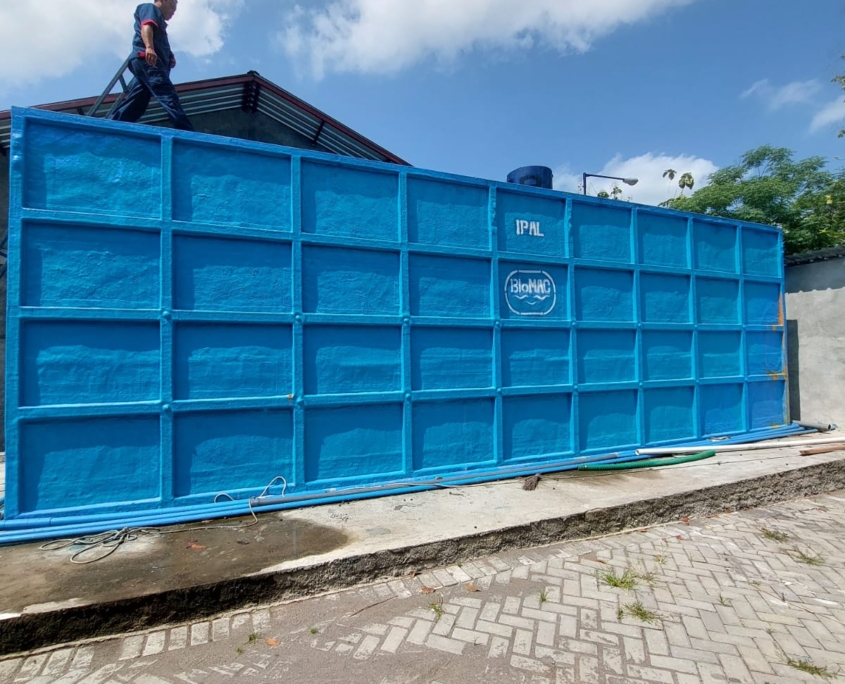
Wastewater Treatment Plant (Instalasi Pengolahan Air Limbah – IPAL Terpusat Kampus Terpadu)
The central IPAL facility utilizes a multi-chamber Anaerobic Baffled Reactor (ABR) configuration combined with aerobic bio-filtration media and settling sedimentation basins, featuring a hydraulic design capacity of up to 200 m³ per day. This multi-stage biological digestion achieves over 85% removal efficiency for Biological Oxygen Demand (BOD), Chemical Oxygen Demand (COD), and Total Suspended Solids (TSS), consistently complying with the national domestic wastewater discharge quality thresholds stipulated in the Regulation of the Minister of Environment and Forestry (PermenLHK No. 68/2016).
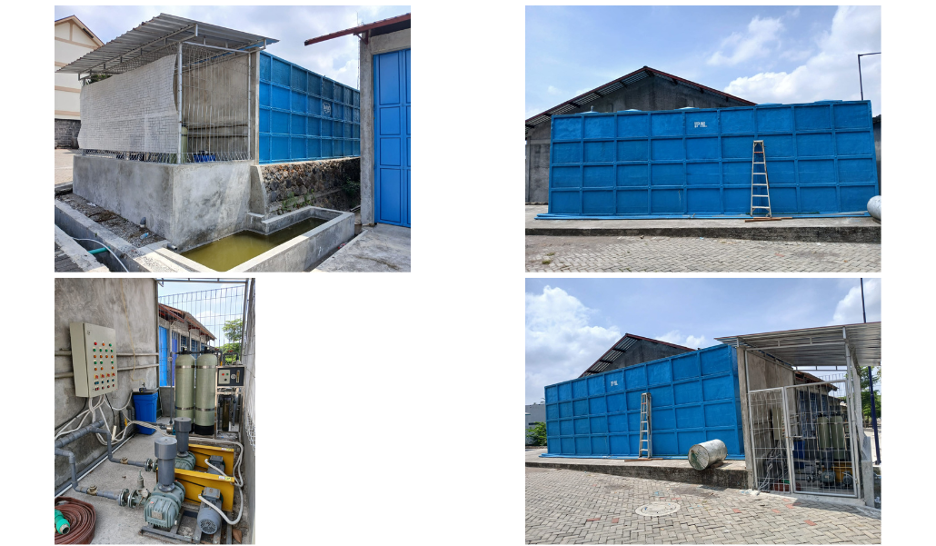
Wastewater Treatment Plant (Instalasi Pengolahan Air Limbah – IPAL Terpusat Kampus Terpadu) – Other View
Treated effluent is safely discharged into campus retention wetlands. Furthermore, commercial grease traps are installed at all campus canteens and food courts to capture fats, oils, and grease (FOG) at the source. The facility produces 25 m³ of treated water per day, which is safely recycled for secondary non-potable uses such as irrigating the campus football field. Furthermore, commercial grease traps are installed at all campus canteens and food courts to capture fats, oils, and grease (FOG) at the source.
| Wastewater Stream | Treatment Facility / Unit | Engineering & Biochemical Process | Statutory Standard & Effluent Fate |
|---|---|---|---|
| Domestic Blackwater & Greywater | Central IPAL (South of Law Faculty Building) | Multi-chamber Anaerobic Baffled Reactor + Aerobic Bio-filter + Sedimentation (120 m³/day) | PermenLHK No. 68/2016 Compliant; Safe environmental discharge into campus wetlands |
| Campus Food Court Sullage | Decentralized Kitchen Grease Traps | Baffled gravity oil-water separation & solid food waste trapping | Fats, oils, and grease (FOG) intercepted before entering sewer line |
| Hazardous Chemical Lab Effluent | Integrated Laboratory (Lab Terpadu UII) | Precipitation, neutralization, activated carbon adsorption & specialized containment | Strict B3 segregation; formal transfer to licensed hazardous handler (PT PPLI) |
| Ablution (Wudhu) Greywater | Ulil Albab Mosque Filtration Unit | Rapid sand-gravel gravity filtration & subterranean storage (~1,000–1,500 L/day) | 100% recycled for on-campus landscape watering and botanical gardens |
Prevention of Polluted Water
Universitas Islam Indonesia enforces a zero-pollution policy to protect campus stormwater conduits, surface retention reservoirs, and local shallow groundwater tables from toxic or chemical contamination. Overseen by the Directorate of Occupational Health, Safety, and Environment (DK3LH) and the Directorate of Integrated Laboratories (Direktorat Laboratorium Terpadu), UII enforces strict chemical segregation and hazardous waste (B3) containment protocols under standard operating procedures (SOP-B3-UII).
Toxic solvents, heavy metals, strong acids, bases, and bio-hazardous microbiological wastes from research laboratories are strictly forbidden from entering campus drains or sewer lines. Instead, liquid chemical effluents are segregated at source into color-coded UN-standard containment drums located within dedicated, ventilated hazardous waste temporary storage depots (TPS Limbah B3). Non-treatable hazardous residues are formally transferred to licensed third-party environmental waste handlers (PT Prasadha Pamunah Limbah Industri – PPLI) under formal electronic manifests (FESTRONIK) certified by the Ministry of Environment and Forestry (KLHK). Furthermore, outdoor maintenance yards maintain spill response containment kits to intercept petroleum hydrocarbon runoff.
Provision of Free Drinking Water
To ensure universal access to clean, potable drinking water while eliminating single-use plastic waste across campus, Universitas Islam Indonesia maintains a network of 24 free smart potable water refilling stations across high-density academic and administrative buildings on Kampus Terpadu. This network serves as Phase 1 of UII’s university-wide safe drinking water rollout, accessible 24/7 to students, faculty, staff, and campus visitors.
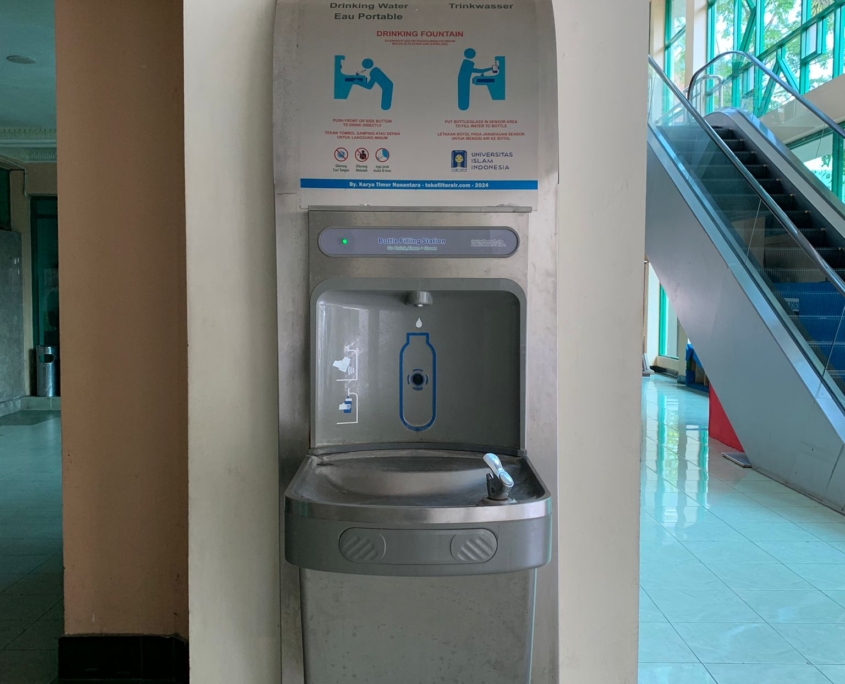
Free Water Refill Station in Mosque Area
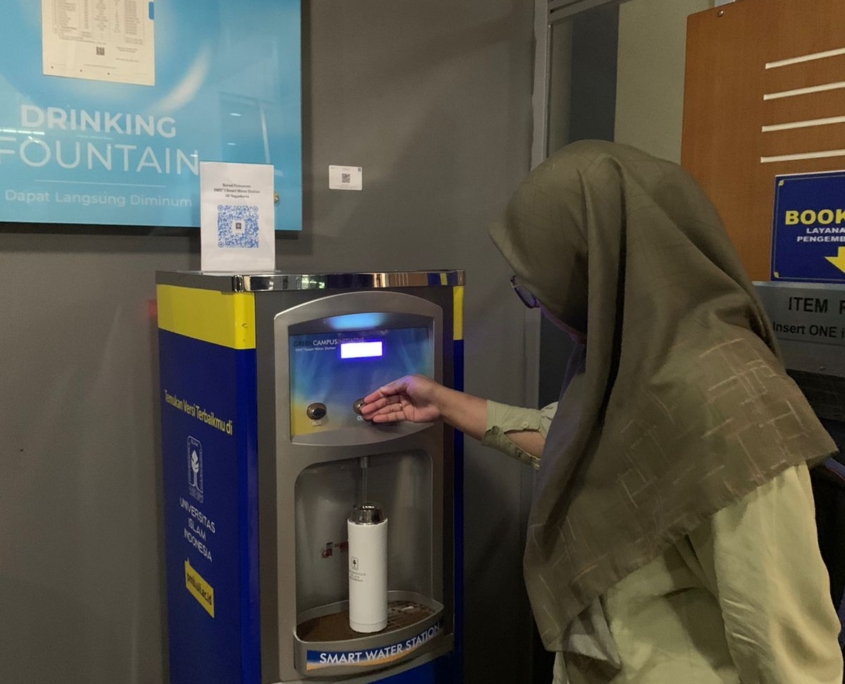
Free Drinking Fountain
To distinguish campus water applications: general utility and sanitary water is processed from deep groundwater wells through the campus Water Treatment Plant (WTP) utilizing rapid silica sand and activated carbon filtration beds. For potable drinking water, each refilling station employs point-of-use multi-stage Reverse Osmosis (RO) semi-permeable membrane filtration paired with post-filtration ultraviolet (UV) sterilization units. To guarantee strict compliance with national drinking water quality standards (Minister of Health Regulation No. 2 of 2023 / Permenkes No. 2/2023), water samples from each station are collected and tested on a regular monthly schedule by the accredited Environmental Engineering Water Quality Laboratory (Laboratorium Kualitas Air FTDI UII), verifying zero Coliform/E. coli detection and optimal Total Dissolved Solids (<50 ppm).
| Refilling Station Node | Specific Campus Building / Placement | GPS Coordinates | Filtration Technology | Laboratory Quality Compliance |
|---|---|---|---|---|
| FTI Lantai 1 | Faculty of Industrial Technology, Ground Floor Main Lobby | -7.686613, 110.410464 | Multi-Stage RO + UV | Permenkes No. 2/2023 Compliant |
| FTI Lantai 2 - Utara | FTI Building, North Wing Floor 2 Corridor | -7.686275, 110.410839 | Multi-Stage RO + UV | Permenkes No. 2/2023 Compliant |
| FTI Lantai 2 - Selatan | FTI Building, South Wing Floor 2 Corridor | -7.686483, 110.410754 | Multi-Stage RO + UV | Permenkes No. 2/2023 Compliant |
| FTI Lantai 3 | FTI Building, Floor 3 Lecture Hall Area | -7.686255, 110.410843 | Multi-Stage RO + UV | Permenkes No. 2/2023 Compliant |
| FTI Lantai 4 | FTI Building, Floor 4 Student Commons | -7.686260, 110.410899 | Multi-Stage RO + UV | Permenkes No. 2/2023 Compliant |
| Lab FTI Lantai 1 - Tengah | FTI Laboratory Complex, Ground Floor Central | -7.687062, 110.410459 | Multi-Stage RO + UV | Permenkes No. 2/2023 Compliant |
| Lab FTI Lantai 1 - Timur | FTI Laboratory Complex, Ground Floor East Wing | -7.687133, 110.410704 | Multi-Stage RO + UV | Permenkes No. 2/2023 Compliant |
| Lab FTI Lantai 2 - Tengah | FTI Laboratory Complex, Floor 2 Central | -7.687061, 110.410402 | Multi-Stage RO + UV | Permenkes No. 2/2023 Compliant |
| Lab FTI Lantai 2 - Timur | FTI Laboratory Complex, Floor 2 East Wing | -7.687192, 110.410666 | Multi-Stage RO + UV | Permenkes No. 2/2023 Compliant |
| FTDI - Barat | Faculty of Civil Eng. & Planning (FTDI), West Lobby | -7.687090, 110.412286 | Multi-Stage RO + UV | Permenkes No. 2/2023 Compliant |
| FTDI - Timur | Faculty of Civil Eng. & Planning (FTDI), East Corridor | -7.687354, 110.412664 | Multi-Stage RO + UV | Permenkes No. 2/2023 Compliant |
| FMIPA Lantai 1 - Timur | Faculty of Math & Science, Ground Floor East Wing | -7.687759, 110.412865 | Multi-Stage RO + UV | Permenkes No. 2/2023 Compliant |
| FMIPA Lantai 1 - Barat | Faculty of Math & Science, Ground Floor West Wing | -7.687670, 110.412558 | Multi-Stage RO + UV | Permenkes No. 2/2023 Compliant |
| FMIPA Lantai 2 - Timur | FMIPA Building, Floor 2 East Wing | -7.687730, 110.412833 | Multi-Stage RO + UV | Permenkes No. 2/2023 Compliant |
| FMIPA Lantai 2 - Barat | FMIPA Building, Floor 2 West Wing | -7.687702, 110.412470 | Multi-Stage RO + UV | Permenkes No. 2/2023 Compliant |
| FMIPA Lantai 3 - Timur | FMIPA Building, Floor 3 East Wing | -7.687693, 110.412778 | Multi-Stage RO + UV | Permenkes No. 2/2023 Compliant |
| FMIPA Lantai 3 - Barat | FMIPA Building, Floor 3 West Wing | -7.687719, 110.412539 | Multi-Stage RO + UV | Permenkes No. 2/2023 Compliant |
| FH Lantai 1 - Depan | Faculty of Law Building, Ground Floor Front Lobby | -7.689127, 110.413060 | Multi-Stage RO + UV | Permenkes No. 2/2023 Compliant |
| FH Lantai 1 - Belakang | Faculty of Law Building, Ground Floor Rear Corridor | -7.689225, 110.412613 | Multi-Stage RO + UV | Permenkes No. 2/2023 Compliant |
| FH Lantai 2 - Depan | Faculty of Law Building, Floor 2 Front Lobby | -7.689216, 110.413170 | Multi-Stage RO + UV | Permenkes No. 2/2023 Compliant |
| FH Lantai 2 - Belakang | Faculty of Law Building, Floor 2 Rear Corridor | -7.689210, 110.412564 | Multi-Stage RO + UV | Permenkes No. 2/2023 Compliant |
| FH Lantai 3 - Depan | Faculty of Law Building, Floor 3 Front Lobby | -7.689157, 110.413107 | Multi-Stage RO + UV | Permenkes No. 2/2023 Compliant |
| FH Lantai 3 - Belakang | Faculty of Law Building, Floor 3 Rear Corridor | -7.689184, 110.412603 | Multi-Stage RO + UV | Permenkes No. 2/2023 Compliant |
| Gedung Rektorat | GBPH Prabuningrat Central Admin Building, Main Reception | -7.687976, 110.413673 | Multi-Stage RO + UV | Permenkes No. 2/2023 Compliant |
Building Standards to Minimize Water Use
Universitas Islam Indonesia enforces Green Building Guidelines across all newly designed and renovated campus buildings, governed by the Directorate of Occupational Health, Safety, and Environment (DK3LH) through its Division of Facilities and Infrastructure. In alignment with national green building codes (PUPR Regulation No. 21/PRT/M/2021) and Green Building Council Indonesia (GBCI) standards, UII mandates the installation of high-efficiency sanitary fittings.
Mandatory infrastructure specifications include: (1) Dual-flush toilet cisterns operating at low flush volumes (3.0 liters for half flush, 6.0 liters for full flush), reducing sanitary water usage by over 40% compared to traditional single-flush systems; (2) Touchless infrared sensor faucets and timed mechanical push-taps installed across high-traffic restrooms to eliminate tap-running wastage; (3) Aerated faucet nozzles restricting outflow to ≤4.5 liters per minute; and (4) Waterless or low-flow urinals (≤1.0 liter per flush) in male facilities. Furthermore, building plumbing incorporates sub-metering and isolation valves allowing rapid repair of isolated leaks, preventing undetected distribution losses.
Landscaping to Minimize Water Usage
Campus grounds at Universitas Islam Indonesia are intentionally designed according to xeriscaping and ecological landscaping principles, prioritizing native, climate-adapted, and drought-resilient plant species. Across the 35-hectare Kampus Terpadu, over 60% of open grounds are designated as natural green corridors, botanical parks, and biological retention buffers.
Vegetation selections prioritize drought-tolerant tropical species such as Ketapang Kencana (Terminalia mantaly), Bougainvillea, Sansevieria, and drought-hardy Zoysia matrella lawn grass, which require minimal irrigation once established. Where landscape irrigation is required, UII utilizes micro-irrigation drip systems and dedicated root-soaking conduits. Irrigation scheduling is strictly restricted to early morning (before 08:00 AM) and late evening (after 05:00 PM) hours to minimize evapotranspiration losses caused by intense equatorial sunlight. Zero potable or deep aquifer water is allocated to lawn watering.
Universitas Islam Indonesia’s Commitment to Environmental Sustainability
Water Reuse Measures at Universitas Islam Indonesia (UII)
Policy to Maximize Water Reuse
Universitas Islam Indonesia is bound by the Rector’s Regulation on Environmental Sustainability and Resource Conservation, which mandates maximizing the cyclic reuse of water resources across all academic and residential facilities. The institutional policy establishes a closed-loop water management paradigm, requiring greywater reclamation and surface stormwater retention to supplement non-potable campus utility needs.
Under this statutory mandate, large congregational mosques—including the central Masjid Ulil Albab—and faculty prayer rooms (musholla) are designed with segregated plumbing infrastructure that intercepts ablution (air wudhu) runoff. Because ablution water is uncontaminated by organic blackwater or harsh chemical detergents, it represents high-quality greywater that is diverted into dedicated gravity settling tanks and rapid sand-gravel filtration beds. In addition, the campus master plan integrates two centralized stormwater retention reservoirs (Embung Kladunan and Embung Pelang) engineered to harvest wet-season surface runoff, preventing downstream urban flooding while serving as a strategic secondary reservoir for campus maintenance.
Measurement of Water Reuse
Universitas Islam Indonesia systematically monitors and quantifies the volume of water reclaimed and reused on campus. Flow measurements conducted at the primary greywater recovery units demonstrate that the ablution water recycling network at Masjid Ulil Albab yields an average reclaimed volume of 1,000 to 1,500 liters per day (~365–540 m³ annually). This reclaimed greywater is stored in dedicated subterranean cisterns and pumped through a secondary non-potable distribution line used exclusively for campus landscape watering, tree nurseries, and roadway dust suppression.
In parallel, the campus stormwater retention system centers upon two official artificial reservoirs—Embung Kladunan and Embung Pelang—which were developed through government grants to hold and regulate the flow of the Kladunan and Pelang streams crossing Kampus Terpadu. With a combined retention capacity exceeding 12,000 m³, these lakes act as massive natural percolation and recharge zones that replenish the Sleman regional volcanic groundwater aquifer. This artificial lake network is integrated with over 1,500 biopore infiltration holes (lubang biopori) and 45 deep infiltration wells (sumur resapan) distributed throughout campus, ensuring that over 90% of monsoon precipitation is captured and returned to the hydrological cycle rather than lost to storm runoff.
| Conservation / Reuse System | Infrastructure Location | Measured Yield / Capacity | Primary Utilization & Environmental Impact |
|---|---|---|---|
| Ablution (Wudhu) Greywater Recovery | Masjid Ulil Albab & Faculty Mushollas | 1,000 – 1,500 L/day (~450 m³/yr) | Directly replaces deep well extraction for green campus landscape irrigation |
| Embung Kladunan & Embung Pelang | Kampus Terpadu (holding 2 crossing streams) | >12,000 m³ combined capacity | Buffers monsoon flash floods and naturally recharges regional volcanic aquifers |
| Biopores & Deep Absorption Wells | All faculty grounds & open courtyards | 1,500+ Biopores & 45 Deep Shafts | Maximizes local soil infiltration and combats ground subsidence |
| High-Efficiency Sanitary Plumbing | Campus-wide academic & office restrooms | >40% Water Savings vs Standard | Dual-flush cisterns (3L/6L), touchless sensor faucets, and low-flow aerators |
| LAZIS UNISIA Tandon Air Kemanusiaan | Karst Drought Zones in Gunungkidul & Sleman | >500,000 Liters delivered dry season | Emergency tanker fleet deliveries and permanent communal cistern installations |
Water in the Community Measures at Universitas Islam Indonesia (UII)
Educational Opportunities for Local Communities
Universitas Islam Indonesia actively shares its academic expertise in hydrology, sanitation engineering, and water resource management with local communities across the Special Region of Yogyakarta and Central Java. The Department of Environmental Engineering (FTDI UII) regularly organizes accredited community workshops, technical training sessions, and public webinars on domestic water purification, well water disinfection, and watershed conservation.
Key outreach initiatives include: (1) Free training workshops for village community leaders (Kelompok Pemakai Air / PPSP) on constructing domestic rainwater harvesting filtration units (PAH – Penampungan Air Hujan); (2) Training for local high school science teachers and students in laboratory water quality testing protocols; and (3) Free water testing clinics where rural residents can submit well water samples to the FTDI Environmental Engineering Laboratory for microbiological and heavy metal analysis at zero charge.
Support for Water Conservation Off-Campus
Universitas Islam Indonesia extends its institutional water stewardship beyond campus boundaries into water-stressed communities across Yogyakarta. Through the university’s philanthropic foundation, LAZIS UNISIA, UII operates the flagship ‘Sedekah Air Bersih’ and ‘Tandon Air Kemanusiaan’ programs, providing humanitarian clean water relief to drought-stricken villages in Gunungkidul, Kulon Progo, and Sleman regencies.

LAZIS UNISIA Program in Free Clean Water Distribution
During prolonged dry seasons induced by El Niño climate anomalies, LAZIS UNISIA mobilizes fleets of 5,000-liter clean water tanker trucks, delivering over 500,000 liters of potable water directly to remote hamlet water reservoirs. Furthermore, UII finances the construction of permanent communal rainwater collection cisterns (Tandon Air) and solar-powered borehole distribution networks in arid karst limestone regions. Concurrently, through student Community Service (KKN PPM) coordinated by the Center for KKN under DPPM UII, thousands of students collaborate with rural villagers to install biopores, clear silt from river catchments, and restore hillside springs.
Biopores as one of UII’s Commitment for Sustainable Environment
Sustainable Water Extraction Technologies
To ensure that groundwater extraction does not deplete the regional Merapi volcanic aquifer or trigger ground subsidence, Universitas Islam Indonesia deploys sustainable water extraction and recharge technologies. The campus deep borehole wells are engineered with strict hydrological depth casing, preventing the drawdown of shallow unconfined water tables relied upon by neighboring rural communities.
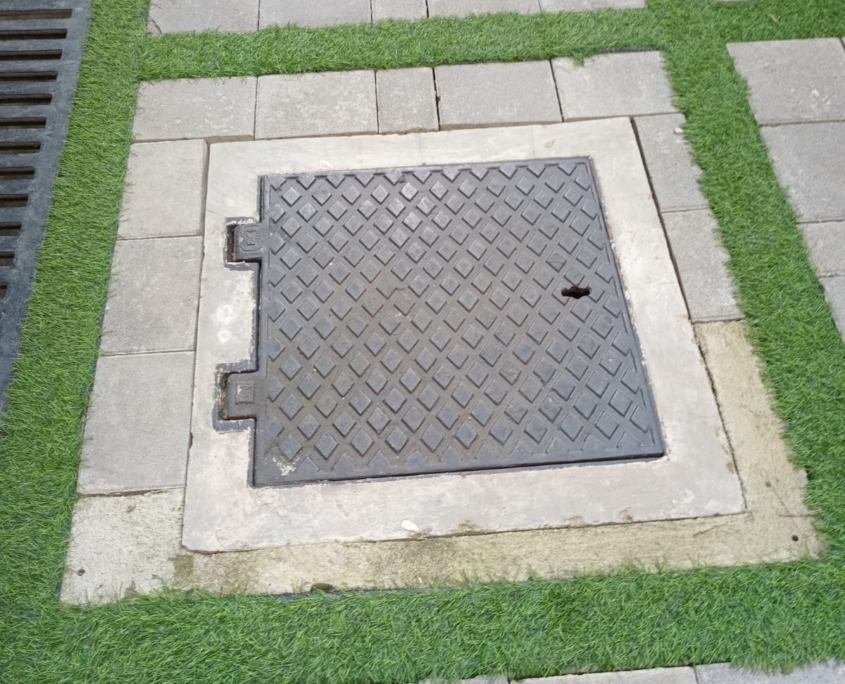
Groundwater Extraction Point
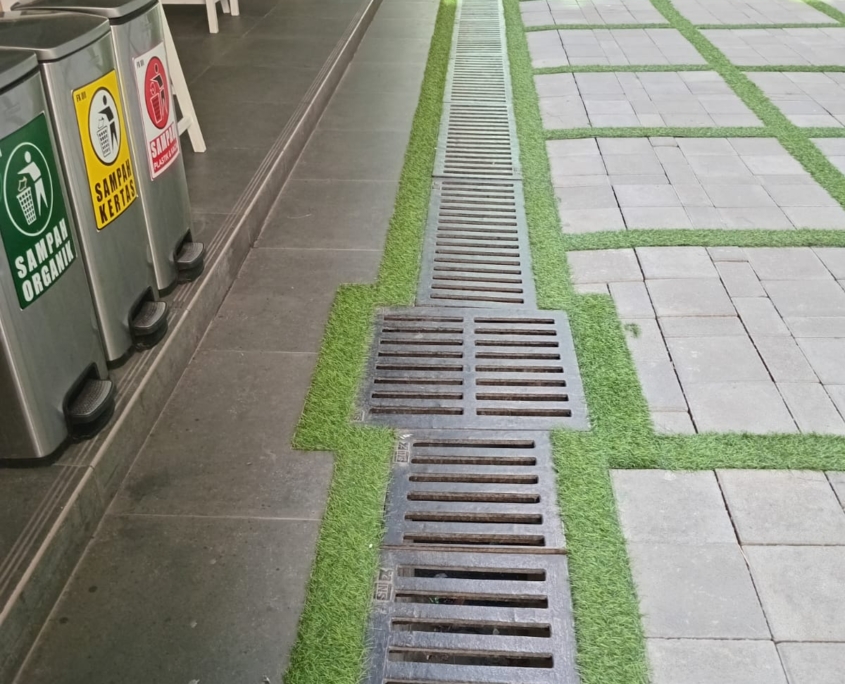
Groundwater Extraction Grills
Groundwater extraction is managed through variable frequency drive (VFD) submersible pumps that automatically adjust extraction rates according to real-time hydrostatic pressure and reservoir level sensors, preventing over-pumping. Furthermore, UII balances every cubic meter of extracted groundwater with artificial aquifer recharge, returning rainfall to deep strata through 45 deep absorption shafts and the two campus retention reservoirs (Embung Kladunan and Embung Pelang). FTDI environmental researchers also develop pilot solar-assisted electrocoagulation and low-energy ultrafiltration units for decentralized, energy-efficient water purification.
Cooperation with Governments on Water Security
Universitas Islam Indonesia serves as a trusted technical advisor and strategic partner to sub-national, national, and international governmental agencies responsible for water resource governance, river basin management, and watershed protection.
Faculty experts from FTDI UII serve on technical consulting panels for the Serayu-Opak-Progo River Basin Center (Balai Besar Wilayah Sungai Serayu Opak – BBWS-SO) under the Ministry of Public Works and Public Housing (PUPR), formulating Integrated Water Resources Management (IWRM) plans for the Opak and Progo river basins. UII scholars also advise the Sleman Environmental Agency (Dinas Lingkungan Hidup Kabupaten Sleman) on local groundwater conservation regulations (Perda Pengelolaan Air Tanah) and evaluate municipal domestic wastewater management networks. Internationally, UII collaborates with partner universities on climate-resilient water governance research.
Water security initiatives by UII’s Water Quality Laboratory
Promotion of Conscious Water Usage
Cultivating an institutional culture of water stewardship is central to Universitas Islam Indonesia’s environmental mission. UII conducts campus-wide, behavior-changing advocacy campaigns that instill water-consciousness among students, faculty, staff, and campus visitors under the ‘Green Campus, Clean Water’ initiative.
Promotional actions include: (1) Prominent water-saving instructional signage placed above every ablution faucet, hand basin, and pantry across all 8 faculties, reminding users that Islamic prophetic tradition explicitly forbids wasting water even at a flowing river; (2) Student orientation modules embedding Islamic environmental ethics and ecological responsibility into freshmen programs; (3) The ‘Bring Your Own Tumbler’ campaign promoted alongside the 24 free RO water refilling stations, drastically reducing disposable plastic bottle purchases; and (4) University-wide social media campaigns and student competitions celebrating World Water Day (Hari Air Sedunia) every March 22nd.
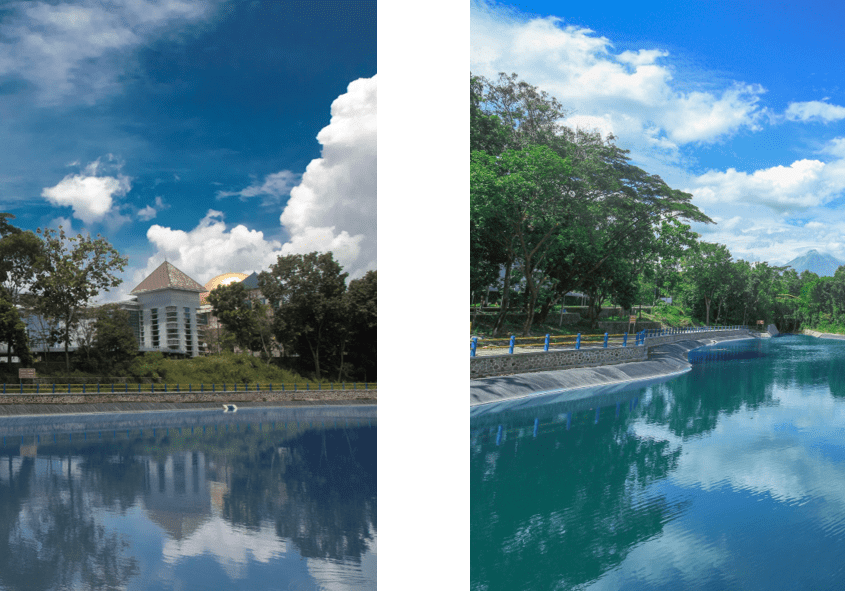
UII’s Water Reservoir – Embung Pelang and Embung Kladuan