Affordable and Clean Energy

Universitas Islam Indonesia (UII) is dedicated to advancing the national clean energy transition through on-site renewable energy generation, rigorous campus energy-efficiency retrofits, and forward-looking environmental stewardship. Grounded in Islamic principles of environmental guardianship (Khilafah fil-Ardh) and aligned with the United Nations Sustainable Development Goal 7, UII manages its institutional energy profile through proactive solar photovoltaic expansion, bioclimatic building design, ISO 50001-aligned energy reviews, and ethical endowment governance that systematically curtails carbon emissions across all university operations.
Renewable Energy Generation & Building Energy Efficiency Highlights
Key clean energy metrics and power conservation milestones across Universitas Islam Indonesia
University Measures Towards Affordable and Clean Energy at Universitas Islam Indonesia (UII)
Energy Efficiency Standards for New Builds and Renovations
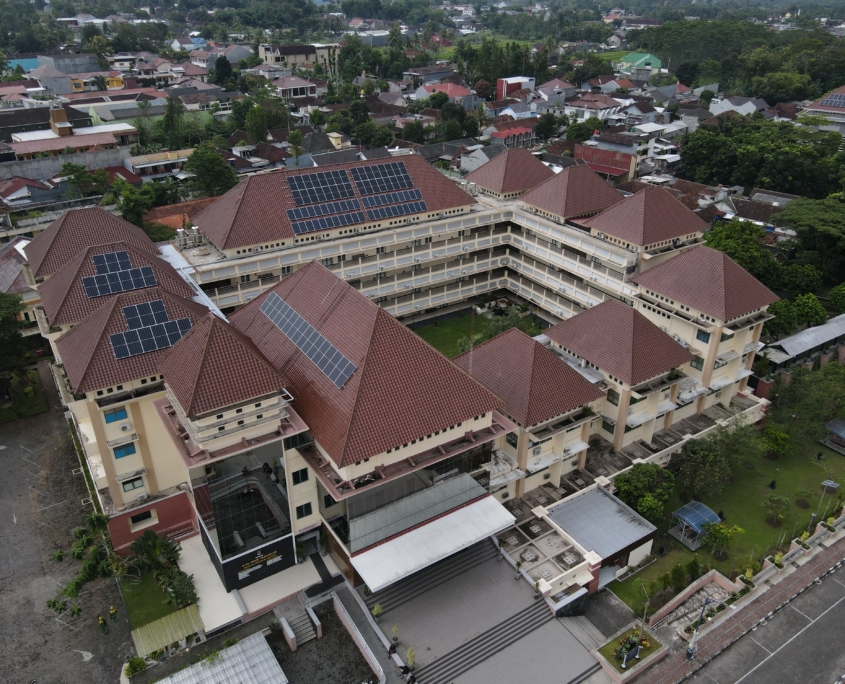
All newly constructed and renovated campus facilities at UII strictly adhere to sustainable building standards codified within the UII Campus Masterplan and Green Building Guidelines. Designed in-house by the Department of Architecture (FTDI UII), the university’s two newest academic complexes—the Faculty of Islamic Studies (FIAI) and the Faculty of Law (FH)—were engineered utilizing Building Information Modeling (BIM) to optimize energy performance, spatial orientation, and thermal comfort.
These landmark complexes incorporate passive bioclimatic design tailored for the tropical climate of Yogyakarta. Structural features include optimized building orientation along the solar axis, deep horizontal overhangs, daylight-responsive shading louvers, and expansive central atriums promoting stack-effect natural cross-ventilation, drastically curtailing the reliance on artificial HVAC cooling and achieving superior energy conservation benchmarks.
Review and Recommendation for Sustainable University by Faculty of Mathematics and Natural Sciences
Plans to Upgrade Existing Buildings for Higher Energy Efficiency
UII executes a continuous institutional modernization roadmap to upgrade existing university buildings to higher energy efficiency tiers. Managed by the Directorate of Asset Management and Estate Facilities, legacy academic buildings undergo phased deep retrofits targeting thermal envelopes, lighting, and mechanical ventilation systems.
Key initiatives include replacing aging air conditioning units with high-efficiency variable refrigerant flow (VRF) and eco-friendly inverter HVAC systems, applying solar-reflective thermal coatings to roof surfaces, and executing campus-wide LED illumination retrofits. Over 88% of campus luminaires have been upgraded to smart, low-wattage LEDs equipped with automated occupancy sensors in public restrooms, stairwells, and lecture halls, generating a measured 22% reduction in lighting electricity demand.
Review and Recommendation for Sustainable University by Faculty of Mathematics and Natural Sciences
Carbon Management and Emission Reduction
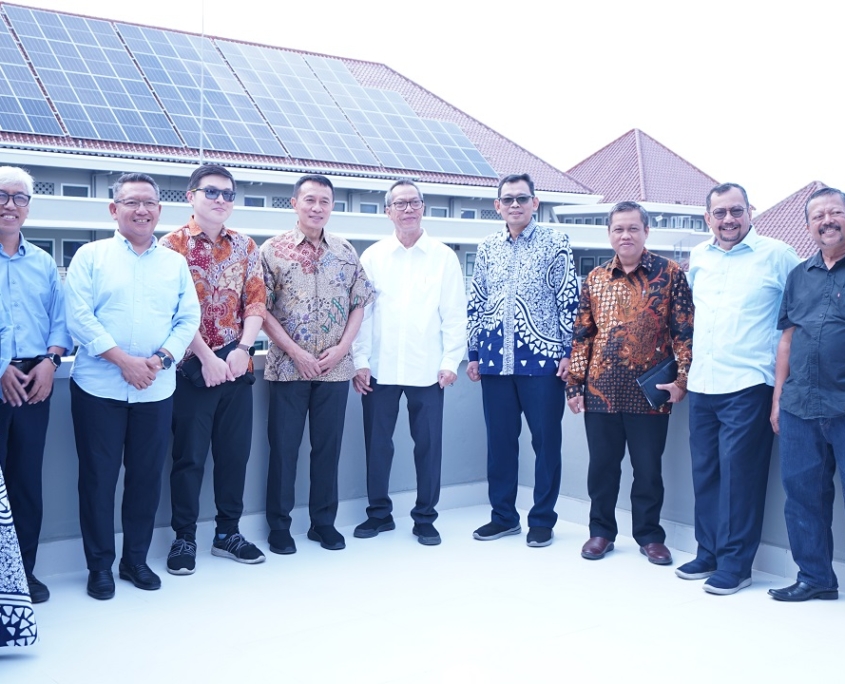
UII actively manages and abates institutional carbon emissions through targeted investments in on-site renewable energy generation and low-carbon operational protocols. The cornerstone of campus clean energy generation is the grid-tied rooftop Solar Photovoltaic (PLTS atap) arrays installed across the engineering complexes (Faculty of Industrial Technology and Faculty of Engineering Design Innovation).
As verified in UII’s official sustainability data, the university utilized 169 GJ of low-carbon and renewable energy within its operational energy mix. These solar installations feed clean electricity directly into departmental microgrids via bi-directional net-metering agreements with the state electricity corporation (PLN), powering specialized computing centers and laboratories while abating dozens of metric tons of CO2 equivalent emissions annually.
Review and Recommendation for Sustainable University by Faculty of Mathematics and Natural Sciences
Energy Efficiency Plan for Reducing Energy Consumption
Institutional energy reduction at UII is operationalized through a university-wide Energy Efficiency Action Plan codified by the Rector’s Directive on Energy Conservation. The plan establishes legally mandated energy conservation protocols across all faculties, research centers, and administrative departments.
Central to this directive is the mandatory temperature set-point calibration for all air conditioning units, strictly standardized between 24°C and 25°C. This measure prevents excessive cooling loads and reduces compressor runtime. Furthermore, building facilities managers enforce scheduled de-energization of non-essential lighting, escalators, and office equipment outside operating hours, supported by active campus energy awareness campaigns.
Review and Recommendation for Sustainable University by Faculty of Mathematics and Natural Sciences
Energy Reviews to Identify Areas of Energy Wastage
UII conducts regular, systematic energy audits across all campus facilities to identify thermal inefficiencies, evaluate electrical distribution loads, and isolate areas of unnecessary energy wastage. Spearheaded by Office of Strategic Initiatives and Sustainability (BISK) in collaboration with the Electrical and Environmental Engineering departments, audits benchmark the Energy Use Intensity (EUI in kWh/m²/year) of every faculty building.
Utilizing infrared thermographic cameras, smart power loggers, and digital sub-metering, review teams assess chiller efficiency, ductwork insulation integrity, and phantom electrical loads. Audit findings are compiled into actionable remediation reports, prioritizing equipment recalibration and targeted retrofits.
Review and Recommendation for Sustainable University by Faculty of Mathematics and Natural Sciences
Policy on Divesting from Carbon-Intensive Energy Industries
UII exercises responsible institutional capital stewardship through the ethical investment mandate enforced by the Waqf Board Foundation (Yayasan Badan Wakaf UII / PYBW), which governs the university’s endowment and capital assets. Operating under strict Islamic Sharia investment principles and environmental ethics, PYBW enforces an ethical screening policy that precludes capital allocations to environmentally destructive, carbon-intensive extractive industries.
The foundation strictly prohibits direct equity investments and corporate lending to coal mining, petroleum extraction, and speculative fossil energy corporations. Instead, endowment assets are strategically channeled into Sharia-compliant sustainable banking, green Islamic sovereign bonds (Green Sukuk), and environmentally sound social infrastructure projects.
Energy and the Community at Universitas Islam Indonesia (UII)
Programs for the Local Community to Learn About Energy Efficiency and Clean Energy
UII actively shares clean energy expertise with the surrounding community through structured educational outreach programs. Coordinated by the Directorate of Research and Community Service (DPPM) and student community service brigades (KKN), faculty from the engineering departments deliver practical workshops on residential energy conservation and renewable technologies for village communities in Sleman Regency.
Topics include household electricity safety audits, transitioning to energy-efficient LED luminaires, and the design and maintenance of off-grid solar-powered streetlights and agricultural water pumps. These educational initiatives empower local citizens with actionable technical knowledge to lower household electricity expenditures while fostering grassroots environmental awareness.
Promoting a Public Pledge Toward 100% Renewable Energy
Demonstrating institutional leadership in climate advocacy, UII has proclaimed a formal Public Pledge committing the university to institutional decarbonization and progressive clean energy transition. Promulgated in academic assemblies and sustainability forums, the pledge establishes a clear trajectory to maximize on-site renewable power generation, transition campus transport to zero-emission mobility, and phase out fossil-derived power.
This public pledge is reinforced through regional community mobilization campaigns—such as the annual ‘Clean Energy for Blue Sky’ cycling events and clean energy exhibitions—which engage regional policymakers, university networks, and youth organizations in advocating for accelerated renewable energy adoption.
Direct Services to Local Industry on Energy Efficiency and Clean Energy
UII provides professional, direct technical consultancy services to regional enterprises and local industrial processing facilities to assist them in measuring and improving their energy efficiency. Managed by accredited laboratory facilities in the Faculty of Engineering Design Innovation (FTDI) and Faculty of Industrial Technology (FTI), university engineering teams conduct monthly diagnostic site visits for manufacturing and food-processing stakeholders.
Services include comprehensive industrial energy audits, electrical power factor corrections, boiler combustion efficiency assessments, and economic feasibility studies for rooftop solar PV adoption. These direct services enable local enterprises to modernize production systems, comply with national environmental regulations, and substantially lower operational operating costs.
Informing and Supporting Government in Clean Energy Policy Development
UII actively informs and supports governmental agencies at local, regional, and national levels in formulating clean energy policies, renewable energy standards, and sustainable urban infrastructure regulations. Academic specialists from UII frequently serve on regional energy advisory taskforces convened by the Energy and Mineral Resources Office (Dinas ESDM) of the Special Region of Yogyakarta.
Faculty contribute policy briefs and technical evaluations on regional electric vehicle (EV) charging infrastructure deployment, decentralized rooftop solar regulations, and municipal building efficiency codes. Through hosting the biennial International Conference on Sustainable Built Environment (ICSBE), UII provides an international academic platform synthesizing scientific evidence into actionable public policy recommendations.
Assistance for Start-ups Supporting Low-Carbon Economy/Technology
UII fosters entrepreneurial solutions for the low-carbon transition through its business incubator, the Business and Technology Incubator (IBT UII / Simpul Tumbuh). IBT provides early-stage incubation, technical mentoring, intellectual property filing support, and seed funding for student and alumni startups developing clean technologies, renewable energy applications, and energy-efficient products.
Incubated ventures gain access to engineering prototyping laboratories, IoT testing benches, and industrial investor pitching networks. Supported ventures include smart agricultural monitoring devices powered by mini-solar panels, automated residential energy-saving switches, and circular biowaste utilization technologies, catalyzing the growth of the regional green economy.
Clean Energy Transition, Infrastructure Efficiency & Sustainable Power Matrix
| Initiative / Policy Area | Strategic Focus & Scope | Operational Evidence & Key Outcomes | Status |
|---|---|---|---|
|
On-Campus Solar Photovoltaic Generation
|
Clean Renewable Electricity Generation
|
Grid-tied rooftop solar panel systems operating across academic facilities, generating clean electrical energy directly into the campus micro-grid.
|
Operational Facility |
|
Universal Energy-Efficient LED Lighting
|
Lighting Load Reduction & Efficiency Upgrade
|
Complete replacement of conventional tube lighting with high-lumen, low-wattage LED fixtures equipped with automated motion sensors.
|
Completed Standard |
|
Passive Green Architectural Standards
|
Thermal Comfort & Energy-Conscious Design
|
Building design guidelines prioritizing natural daylighting, high-ceiling cross-ventilation, and sun-shading fins to curtail air conditioning demand.
|
Architectural Standard |
|
Solar-Powered Autonomous Outdoor Lighting
|
Decentralized Public Infrastructure
|
Self-sustaining photovoltaic streetlights with dedicated battery storage securing night mobility across campus thoroughfares.
|
Active Infrastructure |
|
Campus Energy Performance Auditing
|
Systematic Power Management & Optimization
|
Regular electrical auditing across major faculty complexes, tracking energy intensity metrics and identifying efficiency improvements.
|
Ongoing Protocol |
|
Clean Energy Technology Research & Deployment
|
Applied Clean Energy Innovation
|
Engineering research initiatives developing solar water purifiers, micro-hydro turbines, and biomass dryers deployed in rural communities.
|
Applied Research |